

Calcium is essential for healthy bones, but also for the muscles, nerves and heart. An adequate intake helps prevent osteoporosis, one of the most common health problems associated with ageing bone tissue. High or inappropriate doses of calcium can, however, also carry risks. In this article, we look at what the body needs calcium for, where to find it, how much to take in each day and when supplementation can actually do harm.
What will you learn in this article?
- Calcium and its metabolism in the body
- Natural sources of calcium
- Recommended calcium intake
- What affects and disrupts calcium absorption?
- How calcium works with magnesium
- What are the signs of calcium deficiency?
- Who is calcium supplementation suitable for?
- Our solution: Organic powder from wild-growing seaweed as a source of calcium
- Trime products = safety first
- When to avoid calcium supplementation and what are the risks?
- Calcium and osteoporosis
- Key takeaways
Calcium and its metabolism in the body
Calcium is the most abundant mineral element in the human body. Almost 99% of it is found in our bones and teeth, where it occurs together with phosphorus in the form of hydroxyapatite. Calcium plays a key role in:
- maintaining healthy bones
- proper blood clotting
- muscle contraction
- transmission of nerve impulses
-
regulating hormone production and the secretion of certain enzymes
Almost 99% of calcium is found in the bones and teeth, where together with phosphorus it forms hydroxyapatite. The remaining percent circulates in the blood and is essential for the functions described above.
Blood calcium levels are controlled by two hormones:
- Calcitonin (thyroid gland): when calcium levels are high, it promotes calcium deposition in the bones and increases its excretion by the kidneys.
- Parathyroid hormone (parathyroid glands): when levels are low, it promotes the release of calcium from the bones and its reabsorption in the kidneys and, with the help of vitamin D, increases its absorption from the gut.
The bones therefore serve as a calcium reservoir. With a long-term low intake, too much calcium is released from them, which can lead to bone thinning, greater porosity and the development of osteoporosis.
Natural sources of calcium
The human body cannot synthesise calcium on its own, so it needs to be taken in regularly from the diet.
The richest sources of calcium are:
- dairy products (milk, yoghurts, cheeses),
- sardines and anchovies,
- almonds and sesame seeds,
- kale and broccoli,
- green leafy vegetables in general
Recommended calcium intake
The recommended daily intake (according to EFSA) for an adult is 1,000 mg of calcium.
For children from 11 years of age and adolescents, the recommendation rises slightly to 1,150 mg per day. This period is absolutely key for building so-called peak bone mass, which affects bone strength for the rest of your life. [9] That is why it is important for children to get enough calcium from their diet and to encourage regular weight-bearing exercise, which stimulates the growth of bone mass [7].
The tolerable upper intake level (from all sources) for adults is set at 2,500 mg per day.
What affects and disrupts calcium absorption?
Getting calcium into the body is only half the battle. Its absorption naturally decreases with age, and it is also affected by a whole range of external factors.
What supports absorption:
-
Enough vitamin D and vitamin C.
-
A sufficiently acidic environment (pH) in the small intestine.
-
Regular physical activity and weight-bearing exercise.
What causes losses or poorer absorption:
-
High salt intake (sodium increases the excretion of calcium in urine and sweat).
-
Antinutrients such as phytates and oxalates, which form insoluble compounds with calcium, reducing its absorption.
-
High intake of convenience foods, refined sugar, coffee and alcohol.
-
Smoking, lack of exercise and ageing.
-
Taking certain medications (e.g. corticosteroids, some diuretics or proton pump inhibitors).
In older people, these factors often add up: food intake decreases, vitamin D is lacking and calcium retention by the kidneys gets worse.
How calcium works with magnesium
Magnesium is a mineral that works closely with calcium to regulate nerve impulses and muscle contractions. The recommended intake ratio of these two minerals should be 2:1 in favour of calcium. Supplementing calcium alone can therefore upset the balance between calcium and magnesium in the body and lead to possible health complications.
We covered the topic of mineral absorption and antinutrients in food in more detail in the article "The absorption of mineral substances in the human body and what can we do to improve it?"
What are the signs of calcium deficiency?
Calcium deficiency, or hypocalcaemia, can show up, for example, as cramps, muscle twitches, nervous sensitivity, insomnia, fatigue, dry skin, brittle nails or dental problems such as irritated gums, brittle teeth or a tendency to tooth decay. In the long term, calcium deficiency can lead to osteopenia (reduced bone mineral density), which can progress to osteoporosis (bone thinning and susceptibility to fractures). In children, an inadequate calcium intake can lead to slower growth and weak bones.
Who is calcium supplementation suitable for?
Taking calcium as a supplement makes sense especially for specific groups of people who cannot get enough from their diet. These include, for example:
-
People with a milk protein allergy, lactose intolerance and vegans.
-
Older people (especially over 65) with reduced absorption.
-
People with malabsorption disorders, such as coeliac disease or Crohn's disease.
-
Pregnant and breastfeeding women (if they cannot cover their calcium needs through diet).
-
People with diagnosed osteoporosis or those whose doctor has recommended it for objective reasons.
- Women in menopause, in whom lower estrogen levels lead to greater bone loss and increase the risk of osteoporosis. Calcium supplementation (together with vitamins D3, K2 and other nutrients important for maintaining bone mass) can help slow this loss.
When supplementing, always count your total daily calcium intake, that is, food + supplements.
Our solution: Organic powder from wild-growing seaweed as a source of calcium
Our customers already know that the Trime brand stands for clean supplements made without unwanted synthetic additives, with compositions as close to nature as possible. We place emphasis on first-class quality as well as an ecological approach.
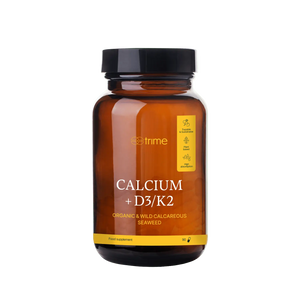
Trime Calcium + D3/K2 is a natural product containing powder from wild-growing calcareous seaweed Lithothamnion superpositum in organic quality. This seaweed is a rich source of bioavailable calcium that our body can use well. It also naturally contains other minerals (including magnesium) that are important for bone health, in a form the human body easily absorbs.
Trime Calcium + D3/K2 is also an ecologically sustainable supplement. The seaweed is not harvested from the ocean but is washed up on the shore naturally. This supports the natural ecosystem with no negative impact on the environment. The washed-up seaweed is then hand-collected, rinsed with fresh ionised water, sun-dried and finally ground into a powder.
For comprehensive health support, we have added vitamin D3 and vitamin K2-MK7 to the calcium seaweed powder. Vitamins D3 and K2 play a fundamental role in calcium metabolism in the body. Vitamin D increases the absorption of calcium from the gut, and vitamin K2 regulates its deposition in the bones and teeth. Together, these three nutrients form a powerful combination that supports not only bone health but also the vascular system.
Trime products = safety first
With our products, we focus not only on top-quality ingredients but also on their safety, and we rigorously check for the possible presence of unwanted contaminants. Minerals, including calcium, can be contaminated with heavy metals. Heavy metals such as lead, cadmium and mercury are toxic, accumulate in the body and can contribute to various health problems. That is why we guarantee heavy metal levels even lower than the permitted limits for our products. This makes them "heavy metal safe" supplements.
You can read more about heavy metals in minerals in our article: Magnesium and heavy metals contamination.
When to avoid calcium supplementation and what are the risks?
A higher dose does not automatically mean a better effect. If you have a varied diet and get enough calcium from food, you do not need to supplement. Excessive intake of calcium can, on the contrary, pose certain health risks: calcium may be deposited in soft tissues and blood vessels (risk of heart attack), or kidney stones may form.
People taking certain medications, such as water tablets (some types of diuretics), lithium, certain stomach medications or heart medications, should also not take calcium without consulting a doctor, as this could lead to unwanted interactions or excessively high blood calcium levels.
Excess calcium, or hypercalcaemia, is not very common. Calcium absorption is limited, and the body excretes any excess through the kidneys. Hypercalcaemia can be caused by certain diseases, such as chronic kidney failure, hyperparathyroidism or cancer.
Calcium and osteoporosis
As we mentioned in the article How to Prevent Osteoporosis, the most important period for preventing this disease is the period of growth and adolescence, when bone mass is formed. According to the National Osteoporosis Foundation (NOF), calcium intake and physical activity have the greatest impact during this time. A large number of studies show that dietary calcium intake or calcium supplementation has a positive effect on bone health in people of different ages, sexes and ethnic backgrounds.
When it comes to osteoporosis and bone health, it should be emphasised that it is not just about getting enough calcium, but about overall lifestyle and nutrition. A comprehensive approach to building strong, healthy bones requires other nutrients, above all enough protein, vitamin D3, vitamin K2 and magnesium, as well as physical activity and adequate loading of the bones. Weight-bearing physical activity has beneficial effects on bone health across all ages. In children and adolescents, it stimulates the growth of bone minerals, while in adults its primary goal is to maintain bone mass.
Key takeaways
-
Calcium is an essential mineral for the body: Almost 99% of calcium is found in the bones and teeth, but it is also involved in blood clotting, muscle contraction, the transmission of nerve impulses and the regulation of certain hormones and enzymes.
-
Diet should be the primary source: The body cannot make calcium on its own, so it is important to get it regularly from foods such as dairy products, sardines, anchovies, nuts, seeds, kale, broccoli or green leafy vegetables.
-
The recommended intake depends on age: According to EFSA, the recommended daily calcium intake for adults is 1,000 mg per day, while for children from 11 years of age the need rises to around 1,150 mg per day due to growth and building bone mass.
-
Many factors affect calcium absorption: Absorption is supported by enough vitamin D, a suitable pH in the gut, vitamin C and physical activity. It can be impaired by phytates, oxalates, vitamin D deficiency, high intake of salt, alcohol and coffee, smoking, ageing or lack of exercise.
-
Calcium deficiency can go unnoticed for a long time: It can show up as muscle cramps, twitches, fatigue, insomnia, dry skin, brittle nails or dental problems. A long-term deficiency can lead to osteopenia and even osteoporosis.
-
Excess calcium can pose a risk: Too high a calcium intake, especially from supplements, may be linked to constipation, bloating and flatulence and, in some people, to an increased risk of cardiovascular problems or kidney stones.
-
Supplementation is not suitable for everyone: Calcium supplements can be useful in justified cases, for example with an insufficient dietary intake or increased needs, but they should be taken with regard to individual health status and possible risks. You can learn more about calcium in our podcast with Jakub Přibyl, Calcium: When it's beneficial and when it can harm you.
-
Calcium alone is not enough for healthy bones: Overall lifestyle matters: enough protein, vitamin D3, vitamin K2 and magnesium, regular physical activity and adequate loading of the bones.
Sources:
[1] Bolland MJ, Avenell A, Baron JA, Grey A, MacLennan GS, Gamble GD, Reid IR. Effect of calcium supplements on risk of myocardial infarction and cardiovascular events: meta-analysis. BMJ. 2010 Jul 29;341:c3691. doi: 10.1136/bmj.c3691. PMID: 20671013; PMCID: PMC2912459. https://www.bmj.com/content/341/bmj.c3691
[2] Bolland MJ, Barber PA, Doughty RN, Mason B, Horne A, Ames R, Gamble GD, Grey A, Reid IR. Vascular events in healthy older women receiving calcium supplementation: randomised controlled trial. BMJ. 2008 Feb 2;336(7638):262-6. doi: 10.1136/bmj.39440.525752.BE. Epub 2008 Jan 15. PMID: 18198394; PMCID: PMC2222999. https://www.bmj.com/content/336/7638/262
[3] Li K, Kaaks R, Linseisen J, Rohrmann S. Associations of dietary calcium intake and calcium supplementation with myocardial infarction and stroke risk and overall cardiovascular mortality in the Heidelberg cohort of the European Prospective Investigation into Cancer and Nutrition study (EPIC-Heidelberg). Heart. 2012 Jun;98(12):920-5. doi: 10.1136/heartjnl-2011-301345. PMID: 22626900. https://heart.bmj.com/content/98/12/920
[4] Curhan GC, Willett WC, Speizer FE, Spiegelman D, Stampfer MJ. Comparison of dietary calcium with supplemental calcium and other nutrients as factors affecting the risk for kidney stones in women. Ann Intern Med. 1997 Apr 1;126(7):497-504. doi: 10.7326/0003-4819-126-7-199704010-00001. PMID: 9092314. https://www.acpjournals.org/doi/10.7326/0003-4819-126-7-199704010-00001
[5] Jackson RD, LaCroix AZ, Gass M, Wallace RB, Robbins J, Lewis CE, Bassford T, Beresford SA, Black HR, Blanchette P, Bonds DE, Brunner RL, Brzyski RG, Caan B, Cauley JA, Chlebowski RT, Cummings SR, Granek I, Hays J, Heiss G, Hendrix SL, Howard BV, Hsia J, Hubbell FA, Johnson KC, Judd H, Kotchen JM, Kuller LH, Langer RD, Lasser NL, Limacher MC, Ludlam S, Manson JE, Margolis KL, McGowan J, Ockene JK, O'Sullivan MJ, Phillips L, Prentice RL, Sarto GE, Stefanick ML, Van Horn L, Wactawski-Wende J, Whitlock E, Anderson GL, Assaf AR, Barad D; Women's Health Initiative Investigators. Calcium plus vitamin D supplementation and the risk of fractures. N Engl J Med. 2006 Feb 16;354(7):669-83. doi: 10.1056/NEJMoa055218. Erratum in: N Engl J Med. 2006 Mar 9;354(10):1102. PMID: 16481635. https://www.nejm.org/doi/full/10.1056/NEJMoa055218
[6] Li K, Wang XF, Li DY, Chen YC, Zhao LJ, Liu XG, Guo YF, Shen J, Lin X, Deng J, Zhou R, Deng HW. The good, the bad, and the ugly of calcium supplementation: a review of calcium intake on human health. Clin Interv Aging. 2018 Nov 28;13:2443-2452. doi: 10.2147/CIA.S157523. PMID: 30568435; PMCID: PMC6276611. https://pmc.ncbi.nlm.nih.gov/articles/PMC6276611/
[7] Kohrt, Wendy & Bloomfield, Susan & Little, Kathleen & Nelson, Miriam & Yingling, Vanessa. (2004). Physical Activity and Bone Health. Medicine & Science in Sports & Exercise. 36. 1985-1996. 10.1249/01.MSS.0000142662.21767.58. https://journals.lww.com/acsm-msse/fulltext/2004/11000/physical_activity_and_bone_health.26.aspx
[8] Murray J Favus, The risk of kidney stone formation: the form of calcium matters, The American Journal of Clinical Nutrition, Volume 94, Issue 1, July 2011, Pages 5–6, https://doi.org/10.3945/ajcn.111.018481
[9] Weaver CM, Gordon CM, Janz KF, Kalkwarf HJ, Lappe JM, Lewis R, O'Karma M, Wallace TC, Zemel BS. The National Osteoporosis Foundation's position statement on peak bone mass development and lifestyle factors: a systematic review and implementation recommendations. Osteoporos Int. 2016 Apr;27(4):1281-1386. doi: 10.1007/s00198-015-3440-3. Epub 2016 Feb 8. Erratum in: Osteoporos Int. 2016 Apr;27(4):1387. PMID: 26856587; PMCID: PMC4791473. https://link.springer.com/article/10.1007/s00198-015-3440-3


