

A woman of reproductive age needs about 18 mg of iron a day, and up to 27 mg during pregnancy. Even so, iron deficiency is one of the most common nutritional deficiencies in women, mainly because of menstruation, pregnancy and breastfeeding. In this article, we look at how much iron women really need by age and life stage, how a deficiency shows up in pregnancy and with periods, and what to do if you need to replenish your iron stores. [2][3]
We covered the general symptoms of iron deficiency, anaemia and testing in detail in our article Iron Deficiency: What Are the Symptoms and How to Replenish It. Here, we focus specifically on what iron deficiency means for the female body and how to address it effectively and safely.
What will you learn from this article?
- How much iron does a woman need?
- Why are women more often iron deficient than men?
- How does iron deficiency show up in pregnancy?
- How is iron linked to menstruation?
- How to find out if you are iron deficient?
- How to raise iron levels in the blood?
- How to choose an iron supplement and how to take it correctly
- When to see a doctor?
- Key takeaways
How much iron does a woman need?
Iron requirements in women change with age and life stage. While men need about 8 mg a day, women of reproductive age need more than twice as much [2].
| Life stage | Recommended daily iron intake |
|---|---|
| Women aged 19–50 (menstruating) | about 18 mg |
| Women after menopause / over 50 | about 8 mg |
| Pregnancy | about 27 mg |
| Breastfeeding | about 9–10 mg |
The higher requirement in menstruating women is linked to regular blood loss. In pregnancy, needs rise because of the mother's growing blood volume and the development of the placenta and the baby. After menopause, requirements fall to roughly the level of men, because there is no longer a monthly blood loss.

Why are women more often iron deficient than men?
Menstruation
The most common cause of iron deficiency in women is regular blood loss during menstruation. The risk rises markedly in women with heavy periods, prolonged bleeding, short cycles, endometriosis or uterine fibroids. Heavy periods are often considered "normal", so many women live with their symptoms for a long time without addressing them.
Pregnancy and breastfeeding
During pregnancy, the mother's blood volume increases, and iron is also essential for the development of the placenta and the growing baby. During breastfeeding, too, the body needs enough iron to rebuild its own stores.
Low intake and higher physical strain
A low iron intake is a risk with a one-sided or calorie-restricted diet, for vegetarians and vegans, and for women who avoid red meat. Losses are also higher in endurance athletes, due to increased red blood cell production, losses through sweat and minor damage to red blood cells during prolonged exercise.
Absorption disorders
Iron deficiency is not always caused by low intake. The problem may be that the body cannot absorb iron well enough, for example with coeliac disease, Crohn's disease, ulcerative colitis or insufficient stomach acid. Autoimmune conditions such as coeliac disease or autoimmune gastritis are also considerably more common in women than in men [4][5].

How does iron deficiency show up in pregnancy?
Iron deficiency is particularly risky in pregnancy, as it affects both the mother and the baby's development. Typical signs include more pronounced tiredness and exhaustion, breathlessness even during normal walking, a pounding heart, paleness and poorer concentration. These symptoms are often put down to the pregnancy itself, so they can go unnoticed for a long time.
Untreated iron deficiency in pregnancy may increase the risk of: [3]
- anaemia in the mother,
- premature birth,
- low birth weight,
- more pronounced tiredness after giving birth.
This is why haemoglobin levels are routinely monitored in pregnancy, along with ferritin if a deficiency is suspected. If you notice more pronounced tiredness, breathlessness or a pounding heart during pregnancy, always discuss it with your gynaecologist, who can assess your values in the context of your whole pregnancy.

How is iron linked to menstruation?
The relationship between iron and menstruation works both ways. Heavy or long periods increase iron losses and the risk of deficiency, while iron deficiency itself can affect the regularity of your cycle and your body's overall energy balance. If your bleeding regularly lasts longer than 7 days, or is so heavy that you need to change your sanitary product every hour, this is a risk factor worth discussing with your gynaecologist, ideally together with a check of your iron stores.
How to find out if you are iron deficient?
Iron deficiency cannot be reliably identified from symptoms alone. Haemoglobin on its own may also miss the early stage, when iron stores are already depleted but anaemia has not yet developed.
The most important markers include:
- ferritin: the most sensitive marker of iron stores,
- haemoglobin and full blood count: reveal possible anaemia,
- transferrin and transferrin saturation: help detect a deficiency at earlier stages,
- CRP: helps distinguish a true deficiency from raised ferritin due to inflammation.
According to the 2020 World Health Organization (WHO) guideline, a ferritin value below 15 μg/l indicates depleted iron stores in women [6]. In clinical practice, however, values below 30 μg/l are often considered a likely deficiency, especially with typical symptoms. Because ferritin is an acute-phase protein, it can be raised during an infection or chronic inflammation despite a real iron deficiency. In such cases, the WHO recommends considering a higher threshold (30 or 70 μg/l) or assessing the result together with CRP [6].
It is also worth checking vitamin B12, folic acid and, in some cases, vitamin B6, as their deficiency can cause symptoms similar to iron deficiency. You can read more about how to recognise a B vitamin deficiency in our article B Vitamin Deficiency: Symptoms, Causes and Best Sources.

How to raise iron levels in the blood?
How quickly your iron stores are replenished depends on whether you are dealing with a mild drop or severely depleted stores, and on the form you choose. The fastest route is to combine a quality food supplement with a diet rich in iron and vitamin C, which supports absorption:
- Vitamin C can increase the absorption of non-haem (plant) iron by up to 300–600% [7]. Combine pulses or leafy greens with citrus fruit, peppers or broccoli.
- Haem iron from red meat, liver or fish is absorbed best, at about 15–35% of the amount consumed [7].
- Coffee, tea and calcium should be taken at least two hours apart from an iron supplement, as they significantly reduce absorption.
What you can realistically expect:
- The first noticeable improvement (less tiredness, more energy) appears for many women within a few weeks of taking a supplement.
- Actually replenishing iron stores (a rise in ferritin) is slower and usually takes 3 to 6 months of regular supplementation.
- Diet alone can only make up for a mild drop in stores. With very low ferritin, it usually works too slowly, so a food supplement or a product recommended by your doctor is advisable.
- With a severe deficiency that does not respond to oral supplements, a doctor may consider intravenous iron, which raises levels much faster. This is always a decision made and monitored by a doctor.
A clinical study in iron-deficient women also showed that taking a dose on alternate days leads to higher total iron absorption than the same dose split into daily intake. This is because a high dose of iron temporarily raises the hormone hepcidin, which limits further absorption for about 24 hours [10][11].

How to choose an iron supplement and how to take it correctly
There are several forms of iron on the market, which differ in absorption and tolerability. Inorganic salts such as ferrous sulphate or ferrous fumarate have long been used, but cause digestive problems in some women. A systematic review of 43 clinical trials with more than 6,800 participants confirmed that ferrous sulphate more than doubles the risk of digestive side effects compared with placebo [8].
Ferrous bisglycinate is one of the best-absorbed and gentlest forms of iron. It is a chelated form in which iron is bound to two glycine molecules, which better protects it as it passes through the digestive tract. Clinical studies show high bioavailability, up to 2–4 times higher than ferrous sulphate, and fewer digestive side effects [9]. This makes it a good choice especially for women with sensitive digestion, pregnant women and long-term supplementation.
Recommended guidelines for taking iron:
- take iron on an empty stomach or between meals, if you tolerate it well,
- take it with water or a drink containing vitamin C,
- do not take it together with coffee, tea or dairy products,
- keep at least two hours between iron and supplements containing calcium, magnesium or zinc,
- with lower doses (about 20–30 mg of elemental iron a day), daily intake is usually suitable; with higher doses, discuss an alternate-day schedule with your doctor.
The optimal form, dose and frequency should always be based on the cause and severity of the deficiency and on your doctor's recommendation.
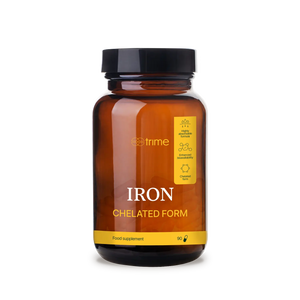
[IMAGE: Trime Iron in chelated form (Iron-chelated-form-trime, desktop + mobile, not uploaded yet)]
When to see a doctor?
A check-up is advisable if you have long-lasting tiredness, weakness, breathlessness, noticeable hair loss or heavy periods. You should also see a doctor during pregnancy, if you have a digestive condition, or if your symptoms and lab values do not improve despite taking iron. It is important not only to replenish your stores, but also to find the cause of their loss. If excessive blood loss or an absorption disorder continues, your stores can become depleted again.
Key takeaways
Iron requirements in women change significantly with life stage: menstruating women need about 18 mg a day, pregnant women up to 27 mg, and after menopause requirements fall to the level of men.
Menstruation, pregnancy and breastfeeding are the main causes of higher risk: these are joined by low dietary iron intake, intense exercise and absorption disorders.
Deficiency in pregnancy is risky for both mother and baby: it may increase the risk of anaemia, premature birth and low birth weight, which is why iron levels are routinely monitored in pregnancy.
A test is more reliable than guessing from symptoms: the key marker is ferritin, ideally assessed together with haemoglobin, transferrin and CRP.
The fastest way to replenish iron is a combination: a quality supplement (such as ferrous bisglycinate) together with a diet rich in vitamin C. The first relief comes within weeks, while actually replenishing your stores takes months.
Form and dosing frequency matter: ferrous bisglycinate tends to be better tolerated, and with higher doses an alternate-day schedule can be more effective, ideally agreed with your doctor.
Sources:
[1] Authorised health claims under Regulation (EU) No 432/2012 (list of permitted claims under Article 13 of Regulation (EC) No 1924/2006). European Food Safety Authority (EFSA), Iron – Nutrition and health claims.
[2] Institute of Medicine. Dietary Reference Intakes for Vitamin A, Vitamin K, Arsenic, Boron, Chromium, Copper, Iodine, Iron, Manganese, Molybdenum, Nickel, Silicon, Vanadium, and Zinc. National Academies Press, 2001. https://www.ncbi.nlm.nih.gov/books/NBK222309/ See also NIH Office of Dietary Supplements, Iron – Health Professional Fact Sheet: https://ods.od.nih.gov/factsheets/Iron-HealthProfessional/
[3] Aslam MF, et al. Iron deficiency in pregnancy – maternal and infant outcomes. Summarised in: Ao Z, et al. Iron Absorption: Factors, Limitations, and Improvement Methods. ACS Omega, 2022;7(24):20441–20456. https://pubs.acs.org/acsodf/article/7/24/20441/418081/Iron-Absorption-Factors-Limitations-and
[4] Sex Difference in Celiac Disease in Undiagnosed Populations: A Systematic Review and Meta-analysis. Clinical Gastroenterology and Hepatology, 2018. https://www.cghjournal.org/article/S1542-3565(18)31256-4/fulltext
[5] Sex-Related Differences in the Diagnosis and Evolution of Parietal Cell Antibody-Positive Autoimmune Gastritis. 2025. https://www.ncbi.nlm.nih.gov/pmc/articles/PMC12897096/
[6] WHO guideline on use of ferritin concentrations to assess iron status in individuals and populations. Geneva: World Health Organization; 2020. https://www.ncbi.nlm.nih.gov/books/NBK569877/
[7] Ao Z, et al. Iron Absorption: Factors, Limitations, and Improvement Methods. ACS Omega, 2022;7(24):20441–20456. https://pubs.acs.org/acsodf/article/7/24/20441/418081/Iron-Absorption-Factors-Limitations-and
[8] Tolkien Z, Stecher L, Mander AP, Pereira DIA, Powell JJ. Ferrous Sulfate Supplementation Causes Significant Gastrointestinal Side-Effects in Adults: A Systematic Review and Meta-Analysis. PLoS One, 2015;10(2):e0117383. https://www.ncbi.nlm.nih.gov/pmc/articles/PMC4336293/
[9] Fischer JAJ, et al. Efficacy and Safety of Ferrous Bisglycinate and Folinic Acid in the Control of Iron Deficiency in Pregnant Women: A Randomized, Controlled Trial. Nutrients, 2022;14(3):452. https://www.mdpi.com/2072-6643/14/3/452
[10] Stoffel NU, von Siebenthal HK, Moretti D, Zimmermann MB. Oral iron supplementation in iron-deficient women: how much and how often? Molecular Aspects of Medicine, 2020;75:100865. https://pubmed.ncbi.nlm.nih.gov/32650997/
[11] Stoffel NU, Cercamondi CI, Brittenham G, et al. Iron absorption from oral iron supplements given on consecutive versus alternate days and as single morning doses versus twice-daily split dosing in iron-depleted women: two open-label, randomised controlled trials. The Lancet Haematology, 2017;4(11):e524–e533. https://pubmed.ncbi.nlm.nih.gov/29032957/


